
How AI Can Rank Your Website in Google: A Practical SEO Guide
Ranking on the first page of Google used to demand months of manual keyword research, content audits, and guesswork. Today, artificial intelligence has compressed that timeline dramatically. AI is no longer a futuristic add-on to SEO — it is quickly becoming the engine behind it. Here is exactly how AI can rank your website, and how you can put it to work starting today.
1. AI-Powered Keyword Research That Finds What Humans Miss
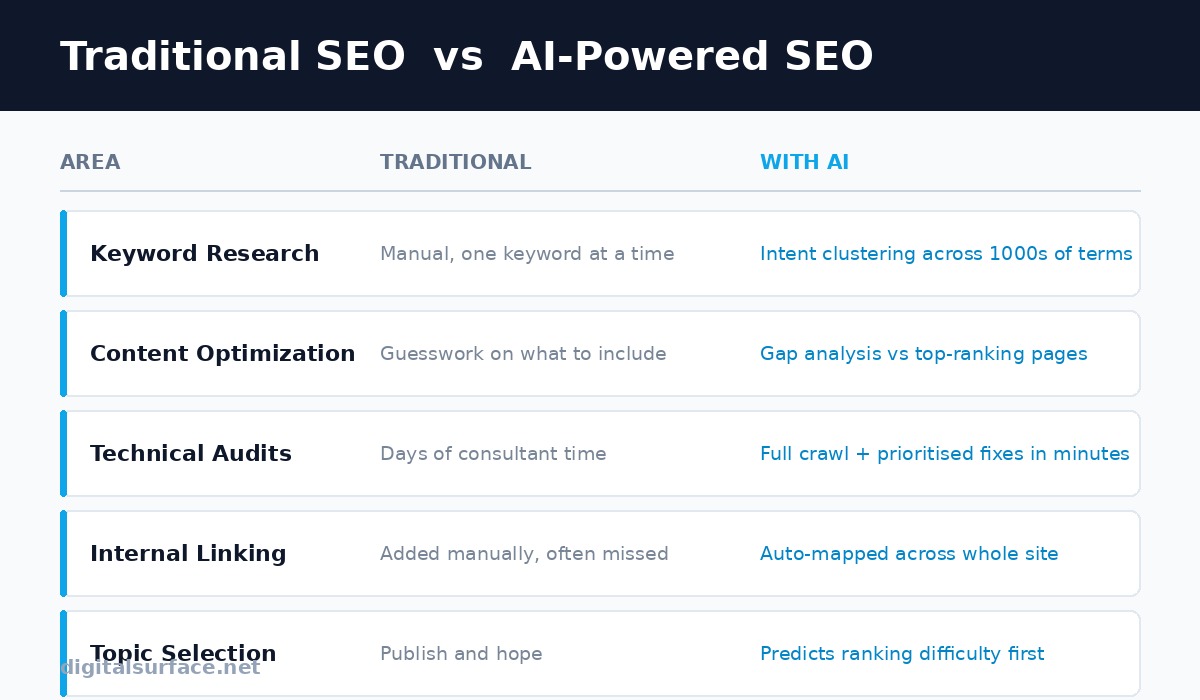
Traditional keyword tools show you search volume and difficulty. AI tools go further — they analyze search intent. Machine learning models can cluster thousands of related queries in seconds, revealing long-tail keywords with real ranking potential that your competitors have overlooked. Instead of chasing one high-competition term, AI helps you build topic clusters that establish genuine authority around a subject, which is precisely what Google’s algorithms reward.
If you are still at the starting line with search optimization, our guide on where to begin with SEO covers the fundamentals that AI tools build on top of.
2. Content Optimization at Scale
Google’s ranking systems, including RankBrain and its neural matching models, evaluate how well your content actually answers a query — not just whether it contains a keyword. AI content optimization tools compare your page against the top-ranking results and highlight gaps: missing subtopics, thin sections, unanswered questions, and readability issues. Writers who use these insights consistently produce content that is more complete and more relevant, and completeness is one of the strongest on-page ranking signals that exists.
The key is balance. Google does not penalize AI-assisted content, but it does penalize unhelpful content. Use AI to research, outline, and refine — then add human experience, original data, and a real point of view. That combination satisfies Google’s E-E-A-T standards (Experience, Expertise, Authoritativeness, Trustworthiness) far better than either humans or machines working alone.
One warning: never let AI mass-produce near-identical pages. As we explained in the case against duplicate content, thin and repetitive pages actively work against your rankings — and AI makes it dangerously easy to create them at scale.
3. Technical SEO Fixes Without the Headache
A slow, crawl-blocked, or poorly structured website will struggle to rank no matter how good the content is. AI-driven site audit tools crawl your website the way Googlebot does and flag broken links, duplicate content, missing schema markup, slow-loading pages, and Core Web Vitals failures — then prioritize the fixes by SEO impact. What once required a technical consultant and a week of analysis now takes minutes, so small businesses can compete on technical health with much larger sites.
This is often the missing piece for frustrated site owners. If you have invested in optimization but seen no movement, our breakdown of why your site isn’t ranking despite having SEO explains the technical blockers AI audits are designed to catch.
4. Smarter Internal Linking and Site Structure
Internal links tell search engines which pages matter most on your site. AI tools map your entire content library and automatically suggest contextually relevant internal links, spreading authority to the pages you want to rank. This quietly powerful tactic lifts rankings across an entire website rather than one page at a time.
5. Predicting What Will Rank Before You Publish
Perhaps the biggest shift: AI can now forecast ranking difficulty and content performance before you invest hours in writing. Predictive models analyze SERP volatility, competitor authority, and content freshness to tell you which topics you can realistically win. That means less wasted effort and a content calendar built on data instead of hope.
6. Optimizing for AI Search Itself
Search is changing on the other side of the screen too. Google’s AI Overviews and assistants like ChatGPT now answer questions directly, citing sources they trust. Ranking today means being citable: clear headings, direct answers, structured data, and factual accuracy make your content easy for AI systems to quote — sending you a new stream of visibility beyond the classic blue links.
How to Start Using AI for SEO Today
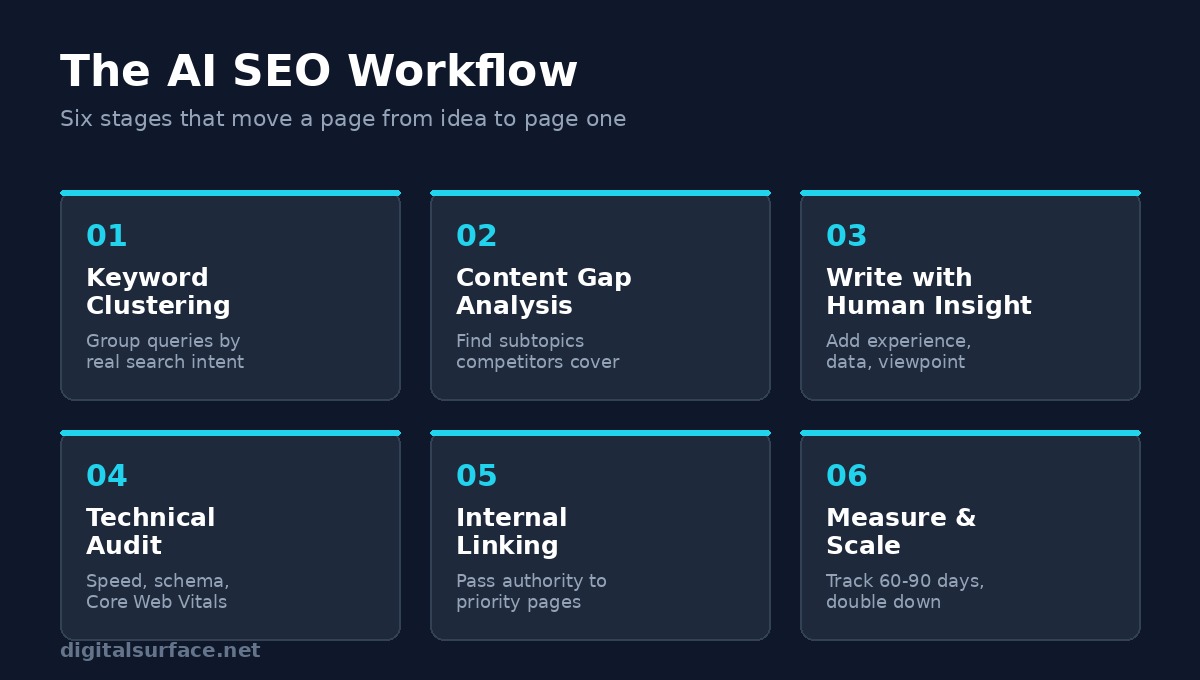
Begin small. Pick one AI SEO tool for keyword clustering, run a technical audit of your site, and use AI to optimize your five most important pages. Measure rankings over 60–90 days, then scale what works. The websites winning in search right now are not the ones with the biggest budgets — they are the ones using AI to work faster, spot opportunities earlier, and publish genuinely helpful content more consistently.
AI will not replace SEO. But businesses using AI for SEO are already replacing the ones that don’t. The sooner your website joins them, the sooner Google starts taking notice.